OpenAI Introduces GPT-6 Sol and GPT-6 Luna: Higher Efficiency and 50 Percent Price Cut
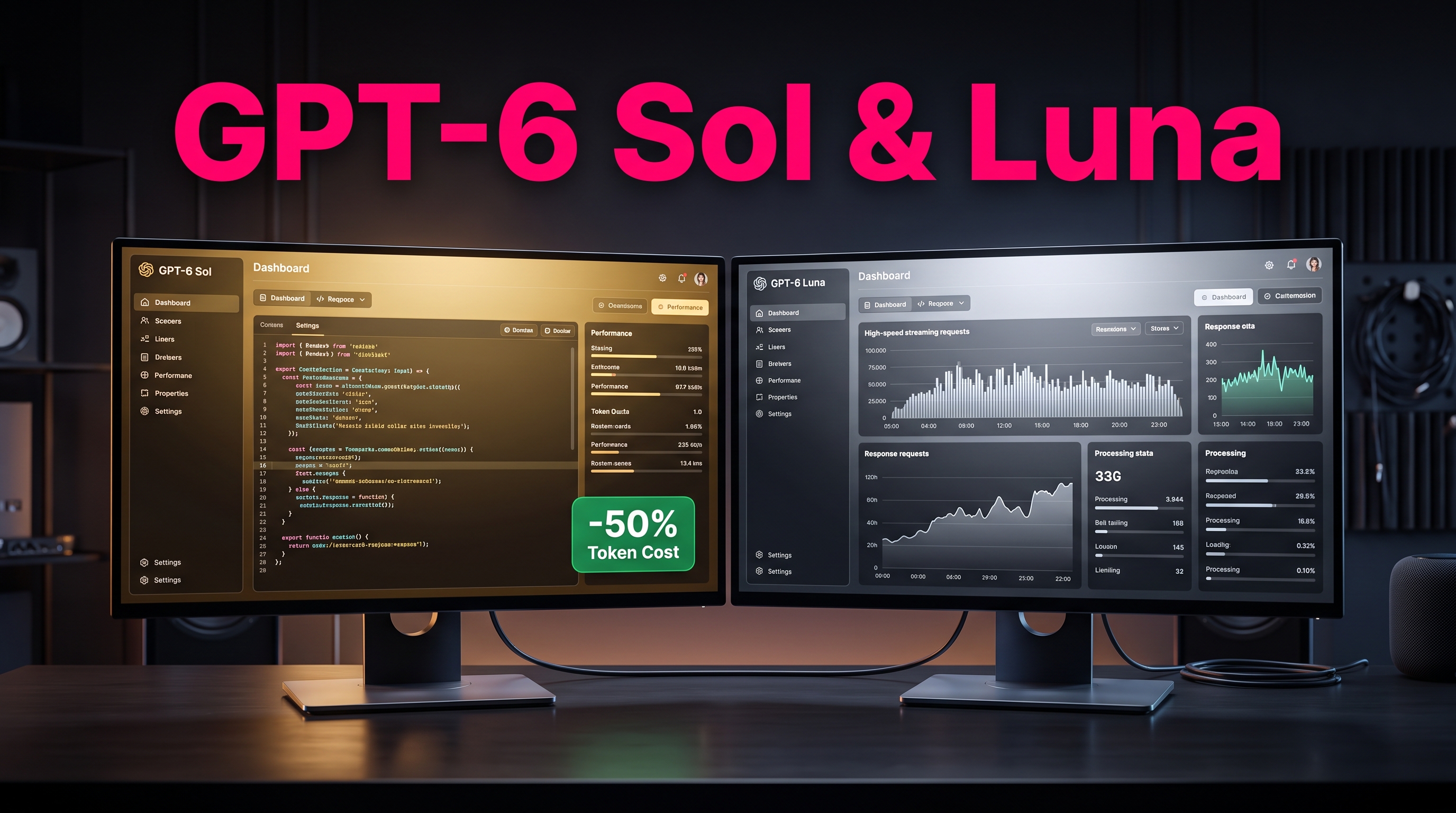
With GPT-6 Sol and GPT-6 Luna, OpenAI expands the GPT-6 lineup with two high-performance, significantly cheaper language models built for everyday production use.
Introduction
OpenAI is expanding its latest model generation with two compelling new additions: GPT-6 Sol and GPT-6 Luna. Following the debut of its flagship model GPT-6 Astra earlier this month, the AI company is now specifically targeting developers, enterprises, and content creators who want to combine cutting-edge frontier intelligence with cost-effective scalability.
Both models bring the architectural breakthroughs and alignment improvements of Astra into more compact, noticeably faster, and, above all, much more affordable formats. While Sol is positioned as a versatile all-rounder for demanding analyses, software engineering, and structured workflows, Luna operates as an ultra-fast, high-throughput specialist designed for routine tasks and agent routing.
At the same time, OpenAI is significantly heating up competition across professional AI solutions: By cutting token prices in half and noticeably reducing latencies, this rollout sets new standards for production-ready AI workflows.
Key Takeaways
* 50% Price Reduction: Compared to their predecessors in the 5.6 series, API prices have been cut in half—GPT-6 Sol costs $2.00 (input) / $10.00 (output) per million tokens, while GPT-6 Luna comes in at just $0.10 / $0.50.
* Intelligent Prompt Caching: Up to 90 percent savings on cached input tokens make agentic, multi-turn systems drastically more affordable.
* More Concise Communication Style: Responses are more direct, substantive, and free of unnecessary filler jargon.
* Immediate Availability: Accessible via the API as well as in ChatGPT Work and Codex for subscribers (Plus, Pro, Business, Enterprise, Edu); Luna is available to free users in the desktop app.
GPT-6 Sol vs. GPT-6 Luna: Tailored for Different Use Cases
The GPT-6 family clearly differentiates by use case and compute requirements, giving developers the freedom to choose between maximum reasoning depth and minimal response latency.
GPT-6 Sol: The All-Rounder for Coding and Complex Reasoning
GPT-6 Sol is the direct successor to the popular GPT-5.6 Sol, utilizing the same alignment and training methodologies as the top-tier Astra model. According to OpenAI, the model cuts the error rate in complex coding and computer-use tasks in half compared to the previous generation. It is ideal for tasks requiring deep contextual understanding, multi-step reasoning, and clean code generation.
GPT-6 Luna: Maximum Speed for High-Volume Operations
Luna is optimized for high-volume applications: data extraction, summarization, classification, and routing within multi-agent networks. With extremely low token pricing ($0.10 per million input tokens), Luna allows developers to embed AI queries into background processes without breaking the budget. At its highest reasoning level, Luna delivers results competitive with previous frontier models like Opus 5—at a fraction of the token cost.
Benchmarks and Price-Performance Ratio
Independent evaluations, such as the Intelligence Index by Artificial Analysis, confirm: The defining leap in this release lies in cost and token efficiency. While raw benchmark performance shows a moderate increase across the board, actual costs per completed task have plummeted by 47 to 61 percent.
| Model | Input / 1M Tokens | Output / 1M Tokens | Cache Read Discount | Primary Focus |
|---|---|---|---|---|
| GPT-6 Luna | $0.10 | $0.50 | Up to 90% | Routing, data extraction, high volume |
| GPT-6 Sol | $2.00 | $10.00 | Up to 90% | Coding, reasoning, workflows |
| GPT-6 Astra | Premium | Premium | 90% | Frontier research, maximum complexity |
Particularly on AutomationBench, which evaluates workflows spanning multiple tools, GPT-6 Sol delivers strong results at high reasoning settings with significantly lower execution costs than competing systems.
Relevance for Content Creation and Workflows
For creatives and content producers, Sol and Luna mean one thing above all: more freedom for iterative experimentation. When text generation and structured data preparation happen in fractions of a second at minimal cost, the entire creative pipeline speeds up.
Textual drafts, storylines, or image descriptions generated with these models can be seamlessly fed into specialized creative tools:
* Detailed storyboards can be turned into vibrant video clips using our /video tool.
* Precise prompt formulations can be plugged directly into the AI /images generator to create consistent artworks.
* Dynamic song lyrics and script excerpts can be transformed into audio using the /music-generator.
As of September 2026, the market clearly shows that top-tier models for specific tasks no longer need to carry extreme compute costs.
FAQ
What is the difference between GPT-6 Sol and GPT-6 Luna?
GPT-6 Sol is engineered for demanding tasks such as programming, computer interaction, and complex logical reasoning. GPT-6 Luna is significantly leaner, exceptionally fast, and primarily designed for routine, high-throughput tasks (e.g., summarization, text filtering, routing).
Where can I access GPT-6 Sol and Luna right now?
The models are available via the OpenAI API as well as in ChatGPT Work and Codex for users on Plus, Pro, Business, Enterprise, and Edu plans. Free accounts can access GPT-6 Luna through the official ChatGPT desktop app.
Why are Sol and Luna so much cheaper than previous models?
OpenAI has implemented optimizations across model architecture, inference pipelines, and particularly prompt caching. By improving context reuse, operating expenses have dropped, enabling standard API prices to be cut by 50 percent.