OpenAI Introduces GPT-6 Sol and GPT-6 Luna: High-End Intelligence at Half the Price
With GPT-6 Sol and GPT-6 Luna, OpenAI expands its GPT-6 lineup with two highly optimized models for everyday work, cutting API prices by 50 percent.
Introduction
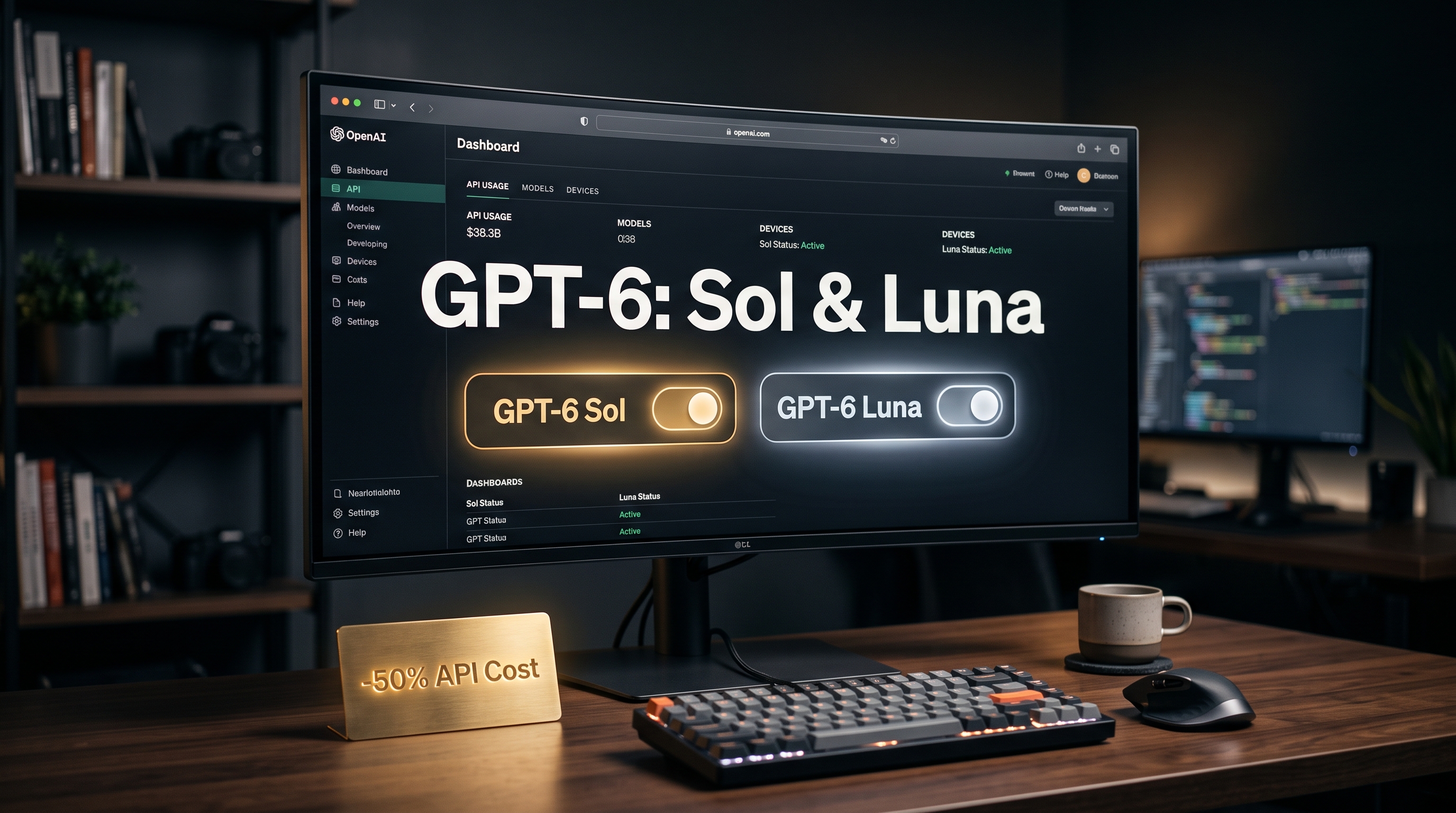
The market for generative artificial intelligence is reaching its next turning point: Just a short time after releasing its flagship model GPT-6 Astra, OpenAI is expanding its portfolio with two new variants—GPT-6 Sol and GPT-6 Luna. Instead of merely pushing performance boundaries higher on academic leaderboards, OpenAI is focusing on a factor that is critical for developers and enterprises: extreme efficiency, drastically reduced costs, and optimized automation capabilities for everyday workflows.
With this release, OpenAI is also responding directly to growing competition from rivals such as Anthropic’s Claude Opus 5.5 and xAI’s Grok 4.7. GPT-6 Sol serves as an intelligent workhorse for demanding development and reasoning tasks, while GPT-6 Luna is designed as a lightning-fast, ultra-affordable foundation for high-volume applications, agents, and daily workflows.
For creators, software developers, and agencies, these new additions unlock unprecedented opportunities for scaling. Anyone managing multimodal content pipelines—such as generating scripts and prompts to turn them into finished content using AIQORA Video or the AIQORA Bild-Generator—now benefits from an incomparably cost-effective token foundation.
Key Takeaways
* 50% Price Reduction on the API: OpenAI is halving prices for Sol and Luna compared to the previous promotional pricing of the preceding GPT-5.6 series.
* Pricing Breakdown: GPT-6 Luna costs just $0.10 per million input tokens ($0.01 cached) and $0.50 for output; GPT-6 Sol is priced at $2.00 input ($0.20 cached) and $10.00 output.
* Solid Performance at Astra Levels: GPT-6 Sol adopts the alignment and reasoning advancements of GPT-6 Astra, achieving a 33% task completion rate on the Artificial Analysis AutomationBench at just $0.27 per benchmark task.
* Availability: Rolling out immediately for Plus, Pro, Business, Enterprise, and Edu customers across ChatGPT Work and Codex, as well as globally via the OpenAI API; Luna is available to free users in the desktop app.
Division of Roles: What Sets GPT-6 Sol and GPT-6 Luna Apart?
OpenAI clearly structures the GPT-6 family by use case and budget. At the top of the performance spectrum sits GPT-6 Astra for absolute peak requirements. For the vast majority of tasks, Sol and Luna share the field:
GPT-6 Sol: The Specialist for Complex Workflows
GPT-6 Sol targets professional environments requiring deep logical reasoning, code architecture, agent orchestration, and computer-use capabilities. The model shines particularly in multi-step tasks where intermediate stages must be chained together without errors.
Despite halving API costs compared to its predecessor GPT-5.6 Sol, Sol delivers consistently high or slightly superior reasoning capabilities across independent benchmarks (such as the Intelligence Index v4.3.2). In agentic workflows across various user interfaces (tested on OSWorld 2.0, among others), GPT-6 Sol clearly outperforms more expensive competitor models in terms of efficiency.
GPT-6 Luna: Ultra-Fast, Scalable, and Dirt Cheap
GPT-6 Luna marks one of the most affordable closed-source models in recent AI history. Priced at just $0.10 per million input tokens and $0.50 per million output tokens, Luna sets a new benchmark for developers processing massive volumes of data, generating summaries in real time, or handling thousands of API requests per minute.
Despite its rock-bottom price, Luna outperforms the previous standard for coding dependencies and routine classification by a wide margin. It eliminates failure rates that were common with earlier budget models and delivers convincing text and code quality.
| Model | Input / 1M Tokens | Cached Input / 1M | Output / 1M Tokens | Primary Focus |
|---|---|---|---|---|
| GPT-6 Luna | $0.10 | $0.01 | $0.50 | High-speed, agents, classification, chatbots |
| GPT-6 Sol | $2.00 | $0.20 | $10.00 | Deep reasoning, coding projects, computer-use |
| GPT-6 Astra | $10.00 | $1.00 | $50.00 | Cutting-edge research, maximum heuristics & benchmark leadership |
(As of September 2026)
The Frontier Model Price War: Why OpenAI Is Striking Now
The release of Sol and Luna is no coincidence—it is a calculated response to the current price war. With competitors ramping up pressure on API margins through models like Claude Opus 5.5 and Grok 4.7, OpenAI is relying on upgraded inference engines and predictable prompt caching.
Thanks to this optimized token infrastructure, OpenAI can pass the cost savings directly on to the developer community. Notably, models like GPT-5.6 Terra have effectively become obsolete, as GPT-6 Sol offers noticeably superior intelligence and context handling at the same entry-level price point.
Relevance for Content Creators and Developers
What do GPT-6 Sol and Luna mean for content creators and developers?
- More Affordable Automation Pipelines: Script generation, transcriptions, automated video concepts, and storyboards cost only a fraction of their previous prices via APIs. This simplifies asset preparation for tools like the AIQORA Musik-Generator or AI-powered voiceovers.
- Faster Feedback Loops in Codex: Within coding environments, Luna delivers near-zero-latency responses, while Sol assists with complex refactoring tasks without blowing the API budget.
- Context Caching as a Standard: At a cached input price of $0.01 (Luna) and $0.20 (Sol) per million tokens, keeping massive knowledge bases and system prompts permanently in cache becomes highly cost-effective.
FAQ
Where can I access GPT-6 Sol and GPT-6 Luna?
Both models are available immediately in OpenAI Codex and ChatGPT Work for Plus, Pro, Business, Enterprise, and Edu subscribers. Developers can integrate both models globally via the official API. Users on ChatGPT’s free tier as well as the Go plan can test GPT-6 Luna within the official desktop app.
How do the models compare to GPT-6 Astra?
GPT-6 Astra remains the ultimate flagship for top-tier cognitive tasks and peak scores on leaderboards; however, it is five times more expensive via the API than Sol and up to a hundred times more expensive than Luna. GPT-6 Sol handles the vast majority of enterprise and coding scenarios at significantly lower operational costs.
Has prompt caching been improved further with GPT-6?
Yes, OpenAI has further optimized its inference and caching mechanisms. Developers benefit from explicit cache breakpoints and drastically reduced prices for cached tokens—dropping as low as $0.01 per million tokens for GPT-6 Luna.