Muse Spark 1.3: Meta's New Coding and Agent Champion Breaks Price Records
With Muse Spark 1.3, Meta introduces a new multimodal reasoning model that sets new standards for coding and agent workflows – at an unbeatable price.
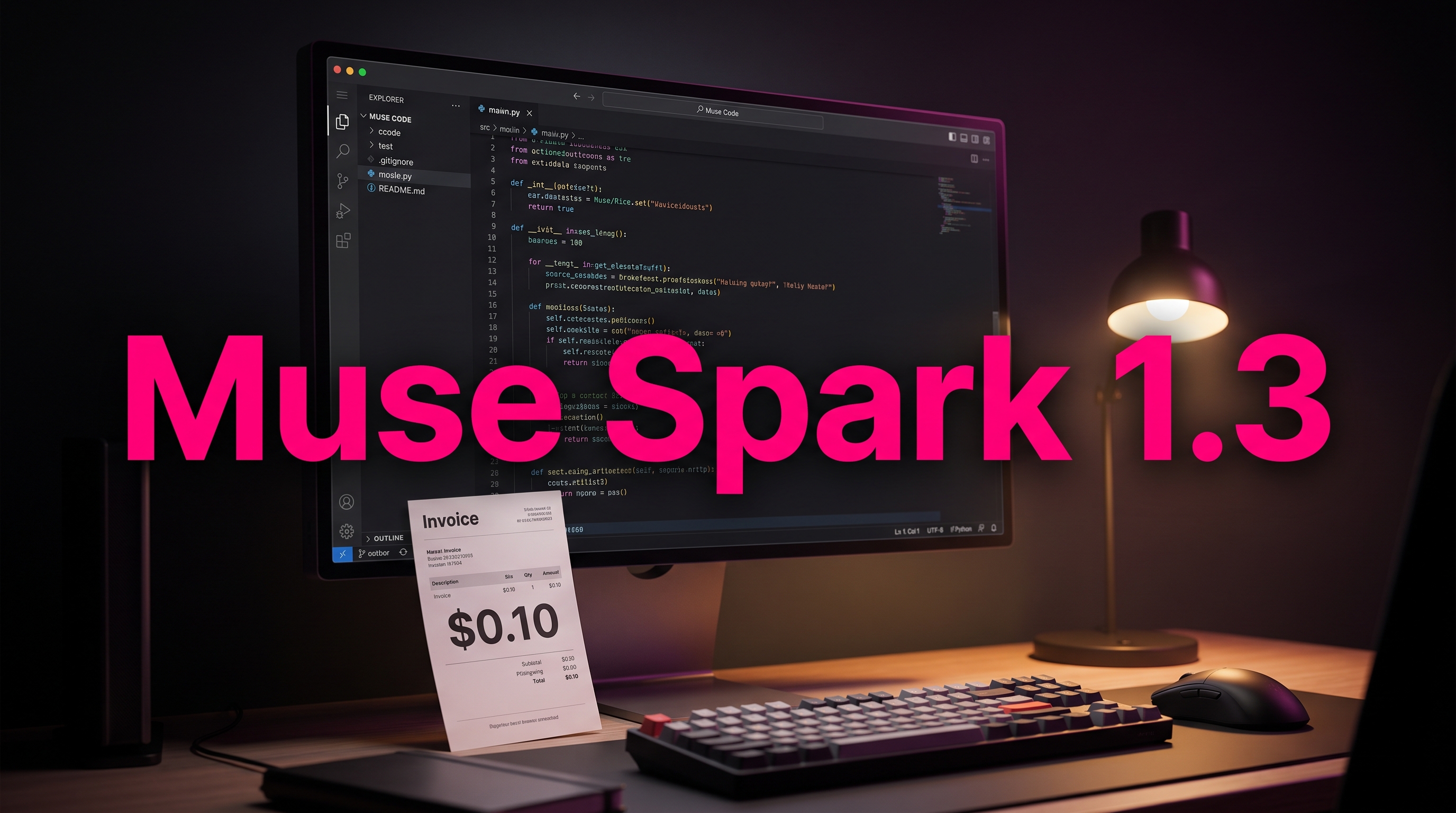
Introduction
Development in the field of artificial intelligence is progressing at a rapid pace. Just a few weeks after previous model releases, Meta officially unveiled Muse Spark 1.3 on September 2, 2026. The latest version of their flagship model focuses specifically on complex, autonomous agent workflows, logical reasoning, and demanding programming tasks.
Although Meta positions the model as a proprietary, closed-source solution, it is already hinting at a future open-weights roadmap. For developers and businesses, the update brings one thing above all: world-class performance in developer environments (such as Muse Code) at a fraction of the cost charged by competing models from Anthropic or OpenAI.
While Muse Spark 1.3 primarily focuses on logical workflows and code generation, creative minds and developers looking to add visual or auditory elements to their projects can rely on AIQORA's versatile creative tools. This allows generated code to be visualized in no time using our Image Generator or turned into animated presentations with the Video Generator.
Key Takeaways
* Massive Context Window: Muse Spark 1.3 processes up to 1,048,576 tokens (1M context), keeping track of even extremely long codebases.
* Top Performance in Coding: In the DeepSWE benchmark v1.1, the model achieves 75.4 points, even beating Claude Opus 5 (74.0 points).
* Unbeatable Pricing: The standard API costs just $1.25 (input) and $4.25 (output) per million tokens. The optional "Contributor Tier" drops the price to a sensational $0.10 / $0.20.
* More Efficient Tool Usage: Compared to its predecessor Muse Spark 1.2, version 1.3 requires around 20% fewer tool calls and saves about 25% on tokens.
* Availability: Since its launch on September 2, 2026, the model can be used via the Meta Model API and Muse Code.
Evolution in Detail: What Makes Muse Spark 1.3 So Powerful?
In developing Muse Spark 1.3 (as of September 2026), Meta focused primarily on robustness and error correction in autonomous agent systems. In complex multi-agent workflows, older models often tend to get caught in infinite loops or accidentally overwrite critical system files. Muse Spark 1.3 shows significantly improved alignment here and is more precise in recognizing when an action is irreversible. In such cases, the model proactively requests confirmation or clarification from the user.
Benchmarks in Comparison: Meta Takes the Coding Crown
Benchmark results published by Meta show that Muse Spark 1.3 is at the very forefront of programming disciplines:
| Benchmark | Muse Spark 1.3 (Max) | Claude Opus 5 | GPT-5.6 Sol |
|---|---|---|---|
| DeepSWE v1.1 | 75.4 | 74.0 | N/A |
| Terminal-Bench 2.1 | 88.8 | 86.7 | 88.8 (Tie) |
| SWE-Atlas | 59.4 | 52.7 | N/A |
(Source: Meta Evaluation Report / Artificial Analysis)
Although Claude Opus 5 is still a tiny bit ahead in some general office and agent tests, Meta outclasses the competition on price.
Two-Tier Pricing and Privacy
Meta is particularly aggressive in its pricing of the API. Developers can choose between two tiers:
- Standard Tier: $1.25 / $4.25 per million tokens. This is already four times cheaper than Claude Opus 5.
- Contributor Tier: A sensational $0.10 (input) and $0.20 (output) per million tokens. The catch: those who use this tier allow Meta to use the entered data for training future models. For highly sensitive corporate code, this tier is therefore usually not an option.
Latency as the Biggest Weakness
Despite all the praise, there is one noticeable downside: response time. Because Muse Spark 1.3 calculates internal logical steps as a "reasoning model" (similar to o1 or Fable models), the so-called Time-to-First-Token in maximum thinking mode (Max Reasoning) can take up to 27.5 seconds. This makes the model unsuitable for real-time chats; its strength clearly lies in asynchronous coding agents running in the background.
Conclusion: A Powerful Tool for Developers
With Muse Spark 1.3, Meta proves that highly advanced logical reasoning and first-class programming skills do not have to be unaffordable. In particular, the improved resistance to prompt injections and the smart balancing of system risks make it an excellent choice for autonomous software agents.
Anyone wishing to combine the productivity of this new coding model with modern content creation will find the ideal complementary tools on AIQORA – from the professional Avatar Generator to engaging audio-to-video applications.
FAQ
When was Muse Spark 1.3 released?
Muse Spark 1.3 was officially unveiled by Meta on September 2, 2026, and made immediately available to developers.
What is the difference between the Standard and the Contributor Tier?
The Standard Tier protects your privacy and costs $1.25 / $4.25 per 1M tokens. In return, the extremely low-cost Contributor Tier ($0.10 / $0.20) allows Meta to use your data and prompts to train its AI models.
Is Muse Spark 1.3 open source?
No, as of today (September 2026), it is a closed-weights model only accessible via the Meta Model API or Muse Code. However, Meta has hinted at potentially releasing an open-weights version in the future.
Why does the first response from Muse Spark 1.3 sometimes take so long?
The model uses advanced reasoning processes ("Reasoning Mode") to logically analyze complex programming problems beforehand. In maximum mode, this thinking process can take up to 27.5 seconds before the first text output is generated.