Claude Opus 5.5 Revealed: Anthropic's New Flagship Sets the Standard for Agents and Coding
Anthropic has released Claude Opus 5.5. Discover everything about benchmarks, 40% cost savings, Adaptive Thinking, and what the model means for developers and creators.
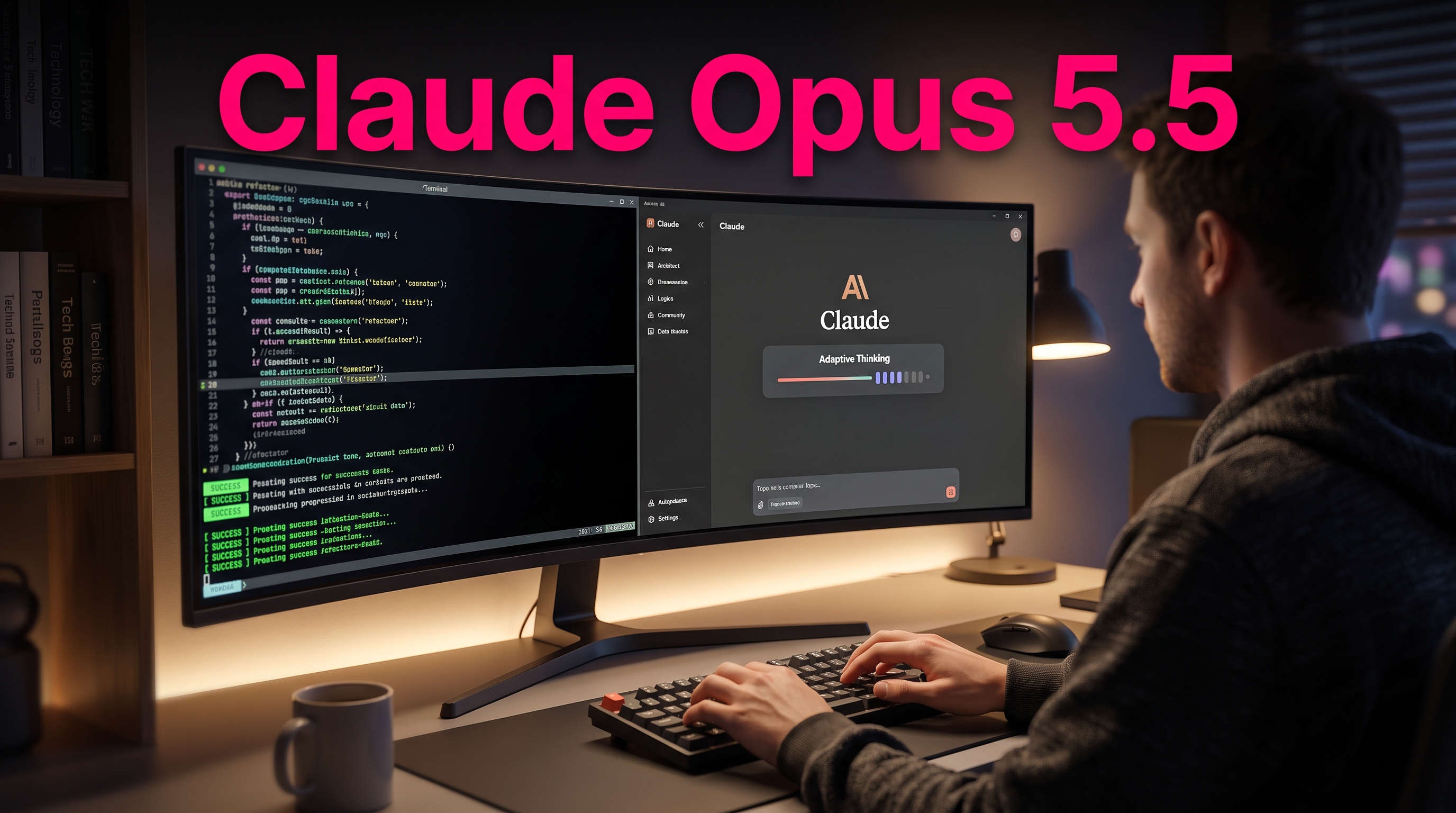
Anthropic has officially introduced Claude Opus 5.5 – the first model of the new 5.5 generation. The release marks a remarkable turning point at the forefront of generative AI models. While previous generational leaps often came with skyrocketing compute requirements and higher API prices, Anthropic is taking the opposite route this time: significantly higher performance at drastically reduced operating costs.
The new flagship model matches the capabilities of Claude Fable 5.1 in benchmark testing, outperforms its direct predecessor Opus 5 across virtually all domains, and specifically addresses the weaknesses of earlier versions in autonomous agent workflows and developer interaction. As a result, developers, content teams, and enterprises gain access to an AI capable of structuring and executing even extraordinarily long multi-step workflows with high precision.
Key Takeaways
* 40% lower overall costs: Despite massive performance improvements, typical operations cost around 40% less than with Opus 5 (API pricing: $4.00 / million input tokens, $20.00 / million output tokens; cache read costs reduced by 60% to $0.20).
Top spot on benchmarks: Opus 5.5 scores 58 points on the Artificial Analysis Intelligence Index (Rank 1), achieving 61.4% on Humanity's Last Exam and 66.9% on SciCode*.
* Gigantic context window: The model processes up to 1,000,000 tokens of context by default and delivers up to 128,000 output tokens in standard requests (and up to 300,000 tokens via the Message Batches API).
* Permanent Adaptive Thinking: Thinking time can no longer be completely disabled; instead, it is adjusted seamlessly via the effort parameter to dynamically balance compute budget and output quality.
What Sets Claude Opus 5.5 Apart?
Claude Opus 5.5 is positioned as a workhorse for complex, multi-stage task pipelines (agentic workflows). Two dimensions stand out in particular: enhanced mathematical-logical capabilities and a fundamentally refined approach to problem-solving.
Industry-Leading Coding and Migration Performance
In everyday software engineering, Opus 5.5 demonstrates its greatest strengths. Early testers report flawless migrations of entire codebases spanning hundreds of thousands of lines within just a few hours—tasks that previously took engineering teams weeks to complete. On Terminal-Bench 4.0, the model achieves peak scores, putting it on par with global frontrunners like OpenAI's GPT-6 series.
The system benefits significantly from its code explainability: Opus 5.5 outlines planned modifications step by step, isolates root causes of errors autonomously, and drastically reduces unintended side effects (regressions) during refactoring.
Efficiency, Caching, and Speed
Beyond raw benchmark numbers, Anthropic has boosted execution speed by more than 30% compared to Opus 5. For latency-sensitive deployments, a dedicated Fast Mode is also available via the API, delivering up to 2.5x faster throughput.
The reduction in prompt caching costs is especially impactful: because modern agents repeatedly read massive amounts of context during extended sessions, the new rate of just $0.20 per million cached tokens read significantly lowers real-world monthly bills for many organizations.
| Metric / Parameter | Claude Opus 5 | Claude Opus 5.5 |
|---|---|---|
| Input Price (per 1M tokens) | $5.00 | $4.00 |
| Output Price (per 1M tokens) | $25.00 | $20.00 |
| Cache Read Price | $0.50 | $0.20 |
| Standard Context Window | 1,000,000 tokens | 1,000,000 tokens |
| Max Output Tokens | 64,000 tokens | 128,000 tokens |
| Reasoning Mode | Optional Thinking | Permanent Adaptive Thinking |
More Natural Communication Instead of Stubborn Pushback
One of the most frequent criticisms of Claude Opus 5 was its tendency to debate user modification requests stubbornly or overcomplicate simple tasks with excessively long internal reasoning loops.
Anthropic intentionally trained Claude Opus 5.5 to put key conclusions first (Bottom Line Up Front), implement instructions without unnecessary lectures, and maintain a pragmatic tone. This makes the model substantially more pleasant to work with—not only for software engineers, but also across copywriting, marketing, and editorial workflows.
Relevance for Creative Professionals and Content Creators
Beyond traditional software development, a model of Opus 5.5's caliber plays an essential role for digital creators:
* Structuring multimedia campaigns: Drafting meticulous storyboards, scripts, and scene prompts for AI video generation benefits directly from the model's logical consistency. Those producing AI clips using modern tools like a /video generator can leverage Opus 5.5 to generate precisely timed shot lists.
* Prompt engineering for image and audio synthesis: Complex visual compositions for an /images generator or song lyrics with specific verse structures and rhythmic instructions for a /music-generator can be drafted with unprecedented precision.
* Data consistency across long-form documents: When producing e-books, whitepapers, or interactive narrative branching, Opus 5.5 never loses the thread, thanks to its 1-million-token context window.
Safety and Responsible Scaling
The release follows recent industry debates regarding the voluntary throttling of frontier model development pacing. Anthropic emphasizes that Opus 5.5 underwent rigorous pre-launch audits conducted by external evaluation bodies, including METR and Frontier Design.
The model incorporates advanced safety classifiers to mitigate misuse in high-risk areas (such as cybersecurity and biology) and demonstrates significantly higher resilience against prompt injections and boundary violations compared to its predecessors.
(As of: September 2026)
FAQ
Where is Claude Opus 5.5 available?
Claude Opus 5.5 is available immediately on claude.ai for Pro, Max, Team, and Enterprise subscribers. Developers can access the model via the Claude API (claude-opus-5-5), Amazon Bedrock, Google Cloud Vertex AI, and Microsoft Foundry.
Can you turn off "Thinking" (reasoning) in Opus 5.5?
No. In Claude Opus 5.5, Adaptive Thinking is permanently enabled. Rather than disabling the thinking mode entirely, developers control reasoning depth using the effort parameter (ranging from minimal effort for basic queries to maximum depth for complex mathematical analyses).
Which other models in the Claude 5.5 family will follow?
Anthropic has confirmed that Opus 5.5 is only the beginning. In the coming weeks, Claude Sonnet 5.5 is slated to launch as a balanced all-rounder, alongside the ultra-lightweight Claude Haiku 5.5.